
Reserve Bank of India (RBI) Governor Sanjay Malhotra on Wednesday said regulations should not create unintended barriers to financial inclusion while emphasising that the impact of regulations on individuals and businesses should be considered.

'My job is to provide people with a bouquet of options they can choose from.'

The Fintech Association for Consumer Empowerment (FACE), the only self-regulatory organisation for financial technology/fintech (SRO-FT) companies, is aiming to secure membership from at least 75 per cent of players across all key fintech categories within the next three years, according to a senior executive. The total number of members in the organisation has increased to 110, up from around 60 when it received approval from the Reserve Bank of India (RBI) to operate as an SRO-FT in August.

In 2024, the National Payments Corporation of India (NPCI) approved 20 third-party Unified Payments Interface (UPI) applications, a record since UPI's launch in 2016. This surge reflects growing interest from financial technology (fintech) companies, driven by the integration of credit products like UPI-linked credit cards and pre-approved credit lines.

By choosing your study destination carefully, leveraging government schemes, comparing loan options, and adopting frugal living practices, Indian students can acquire global credentials without mortgaging their futures.

India's Permanent Representative to the UN Ambassador Parvathaneni Harish said that the Indian sub-continent offers a "stark contrast" in terms of progress, prosperity and development models.

'They wanted the city to be a great business hub. They didn't like the fact that taxes collected in Bombay would go outside the city.'

The first edition of the World Bowling League backed by celebrity cricketer Virat Kohli and baseball star Mookie Betts, will roll out with six franchises competing in iconic locations early next year.
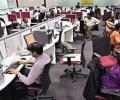
Mid-tier information-technology (IT) companies last financial year reported better growth numbers than their larger counterparts, highlighting their ability to navigate the uncertain macroeconomic environment. Most of these companies - such as Persistent Systems, Coforge, KPIT, and Mphasis - focus on niche businesses and industries that allow them to go deeper in terms of client mining and expanding wallet share from existing customers.

Notably, four portfolio companies-- Agnikul, ePlane, CynLr, and GalaxEye -- of deep-tech investor Speciale Invest made it to the list.

Global energy giant Shell has acquired Mumbai-based Raj Petro Specialities to deepen its foothold in the world's third biggest lubricants market in the world, a top company official said. Shell, which has already invested over $5 billion in India across the energy value chain -- from LNG import terminals and fuel stations to renewable energy and technology centres -- has acquired 100 per cent equity interest in Raj Petro Specialities Pvt Ltd from Germany's Brenntag Group.

Ishwak Singh's earnestness and the rustic energy of his mates keeps Mitti engaging, even when it starts to get preachy, observes Deepa Gahlot.

To check digital frauds, the government has disconnected 70 lakh mobile numbers so far involved in cybercrime or financial frauds, Financial Services Secretary Vivek Joshi said on Tuesday. Emerging from a meeting to discuss issues related to financial cyber security and increasing digital payment fraud, Joshi, who chaired the meeting, said banks have been asked to strengthen the system and processes in this regard. More such meetings would take place, he said, adding the next meeting is scheduled in January.

Fuelled by the global capability centre (GCC) boom, gross leasing of office space across top eight cities soared 5 per cent to touch 21.4 million square feet (msf) in the second quarter of calendar year 2025, according to Cushman & Wakefield's Q2 India Office Market report.

Mutual funds (MFs) have lined up information technology (IT) funds, indicating that technology stocks are back on fund managers' radar after a hiatus. Over the past 18 months, stock prices for companies in the software space have either corrected or remained subdued. Fund houses have launched five IT-based sectoral funds in the past three months, with three of them taking the passive route.
Office space owners are looking at good times ahead as rentals are expected to rise due to demand for Grade A office spaces outpacing supply that has been sluggish due to construction delays, long gestation periods and developers' interests shifting to residential.

The BRICS nations condemned the Pahalgam terror attack, advocated for a zero-tolerance approach to terrorism, and criticized rising tariffs during their summit in Rio de Janeiro. They also addressed global challenges and called for reforms in international institutions.

Reserve Bank of India (RBI) Deputy Governor Swaminathan J criticised some non-banking financial companies (NBFCs) for lax loan appraisal practices and charging excessive interest rates, even as he acknowledged the sector's rapid expansion over the past decade, especially in recent years. "Unfortunately, some NBFCs seem to believe they can operate with weak underwriting in the pursuit of fast growth while levying excessive and unsustainable interest rates - sometimes disguised as upfront or processing fees - followed by aggressive recovery methods in case of default," Swaminathan said at the conference of NBFCs in Chennai last month.

Any industrial policy is only as good as how it is applied and the other reforms that support it. This was as true 40 years ago as it is now, points out Debashis Basu.

The Supreme Court's ruling in the BPSL case exposes deep flaws in the IBC's institutional framework and raises concern about judicial overreach, notes Rajeswari Sengupta.

Some individuals opt for the new regime without a comparative analysis of the tax liability under the two regimes.

Cognizant has said it aims to be back among India's top four IT services companies by 2027 by improving revenue, market share, bagging large deals, and gradual margin expansion. The Nasdaq-listed company does a major part of its business in India, but has trailed peers such as Tata Consultancy Services and Accenture over the last few years as growth tapered, margins squeezed, and attrition soared.

By threatening to punish India with high tariff, Trump is actually planting a tantalising thought in the Indian mind that the Modi government should suitably 'incentivise' him, explains Ambassador M K Bhadrakumar.

About 55 banks participated in the deal, making it the largest bank group for a syndicated loan in Asia so far this year.

'Challenge is basically near-term growth as the outlook has turned a bit adverse.'

President Trump with his MAWA has unwittingly provided us this opportunity. Will PM Modi grasp this and leave a legacy of an ushered in scientific and technological revolution in India, asks Colonel Anil A Athale (retd).

As many as 76 per cent of respondents said they will be willing to sacrifice existing benefits for better ones.
Currently there are 26 licensed players in the P2P lending sector but only 10-11 are actively operating.
Neo banks, along with mid-sized banks, are establishing global capability centres (GCCs) in India, mirroring the expansion strategies of larger global counterparts. This trend is being seen as the next major wave in the country's banking, financial services, and insurance (BFSI) sector.

Airtel has informed the government and regulator Trai that it has approached Reliance Jio and Vodafone Idea with a proposal for a joint initiative to unite the industry against rising telecom fraud and scams.

Valuations at current levels have historically corresponded single-digit returns.

Flipkart Group Chief Executive Kalyan Krishnamurthy on Monday said the firm was advancing preparations for a potential initial public offering (IPO) in India, which included shifting its holding company to India from Singapore. Speaking at an internal town hall, Krishnamurthy said the company's leadership structure is strengthening and that the steps toward relocating Flipkart's legal base to India are progressing as planned, according to people familiar with the matter.

India needs to be technologically and militarily prepared to defend itself from both Pakistan and China, alerts Ramesh Menon.

Satyajit Ray anticipated the issues we are only now starting to raise, long before large language models, AI chatbots, predictive algorithms, and autonomous systems began to control every bit of our lifestyles, notes Atanu Biswas.

Hiring trends in India's white-collar job market dipped marginally by 1.4 per cent in March compared to the same month last year, driven by a decline in recruitment in the retail, oil & gas, and education sectors, a report said on Wednesday.

Consumer durable companies in India have begun early-stage talks with US importers at a time when the tariffs levied on Indian products are lower than those on competitors such as China. While the discussions started some time ago, many believe that the Donald Trump administration's tariff measures will help Indian companies expand their presence in the US market.

Tata Motors is hoping to beat its target year of 2030 and have 30 per cent of its portfolio comprising electric vehicles (EVs), according to Chairman N Chandrasekaran, who was speaking at the company's last annual general meeting (AGM) ahead if its demerger.
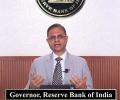
'India has the potential to grow at more than 7%, with the monetary policy providing a supportive hand.'

The government on Tuesday notified the Rs 22,919 crore scheme to promote domestic manufacturing of electronics components, display and camera modules, non-surface mount devices, multi-layer printed circuit boards and lithium-ion cells for digital applications, among others. The scheme is likely to be operationalised in the next 2-3 weeks.
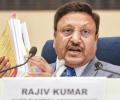
Outgoing Chief Election Commissioner Rajiv Kumar has expressed concerns about long-pending cases questioning electoral processes, arguing they fuel distrust and should be scheduled with consideration for election periods. He also advocated for enhanced transparency in political promises, with clear disclosures on financial viability and impact on state finances. Kumar further stressed the need for a totaliser system to maintain polling station-wise voting confidentiality and urged the empowerment of NRIs to vote remotely. He highlighted the potential of biometric authentication and technology to address issues like impersonation and multiple voting.
